Use this node from the SDK
Add it in Python with
pipeline.add(name="...").llm(...). See the SDK reference.Core Functionality
- Generate text completions and conversational responses using Cohere Command models
- Process system instructions and dynamic prompts with variable interpolation
- Stream responses in real time for long-running generations
- Return structured JSON output with optional schema enforcement
- Track token usage and credit consumption per run
- Apply content moderation, PII detection, and safety guardrails
- Retry failed executions automatically with configurable intervals
Tool Inputs
System Instructions— (String) Instructions that guide the model’s behavior, tone, and how it should use data provided in the promptPrompt— (String) The data sent to the model. Type{{to open the variable builder and reference outputs from other nodesModel* — (Enum (Dropdown), default:command-r-06-2024) Select from available Cohere models. Click Dropdown to view all optionsUse Personal Api Key— (Boolean, default:No) Toggle to use your own Cohere API key instead of VectorShift’s shared keyApi Key— (String) Your Cohere API key. Required whenUse Personal Api Keyis enabled — the node will show a validation error if left blankJSON Schema— (String) JSON schema to enforce structured output format. Only visible whenJSON Responseis enabled in the settings panel
Tool Outputs
response— (String (or Stream<String> when streaming)) The generated text response from the modelprompt_response— (String) The combined prompt and response contenttokens_used— (Integer) Total number of tokens consumed (input + output)input_tokens— (Integer) Number of input tokens sent to the modeloutput_tokens— (Integer) Number of output tokens generated by the modelcredits_used— (Decimal) VectorShift AI credits consumed for this run
- Workflows
Overview
The Cohere LLM node in workflows lets you place a Command model directly on the canvas, wire inputs and outputs to other nodes, and configure model behavior through the settings panel. Cohere models are well-suited for retrieval-augmented generation (RAG) and enterprise search workflows.Use Cases
- Compliance report summarization — Condense lengthy regulatory filings or audit reports into concise executive summaries, highlighting key findings and action items.
- Transaction categorization — Classify financial transactions by type, merchant category, or risk level using natural language understanding.
- Client Q&A from documents — Build knowledge-grounded chatbots that answer client questions about portfolio performance, fund prospectuses, or policy documents.
- Data extraction from filings — Extract structured fields from unstructured financial documents using JSON mode — for example, pulling key terms from loan agreements.
- Multilingual financial content — Generate or translate financial communications across languages for global client bases using Cohere’s multilingual capabilities.
How It Works
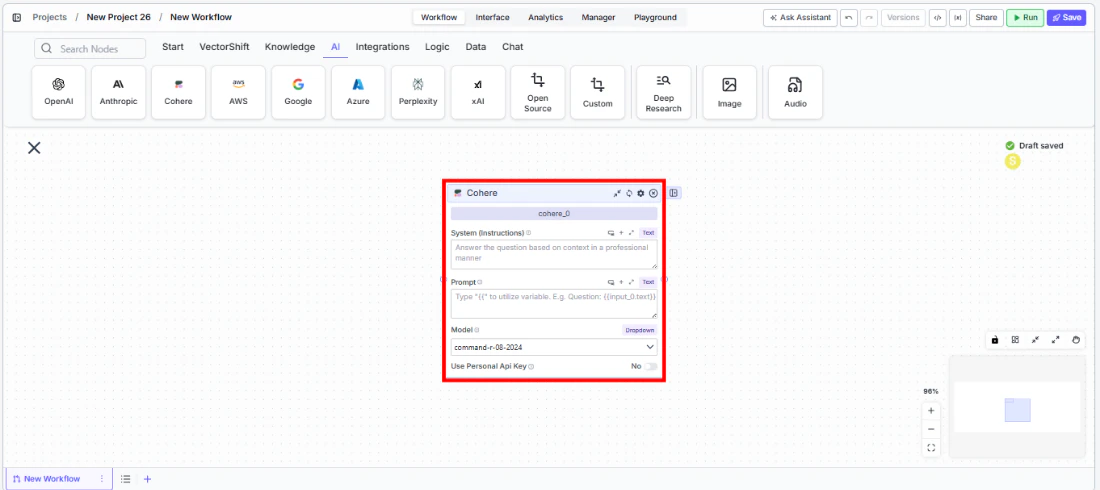
- Add the node to your workflow. From the toolbar, open the AI category and drag the Cohere node onto the canvas.
-
Write your System Instructions. Enter instructions in the
System Instructionsfield to define the model’s behavior, tone, and how it should use any data provided in the prompt. -
Configure the Prompt. In the
Promptfield, type{{to open the variable builder and reference outputs from upstream nodes. -
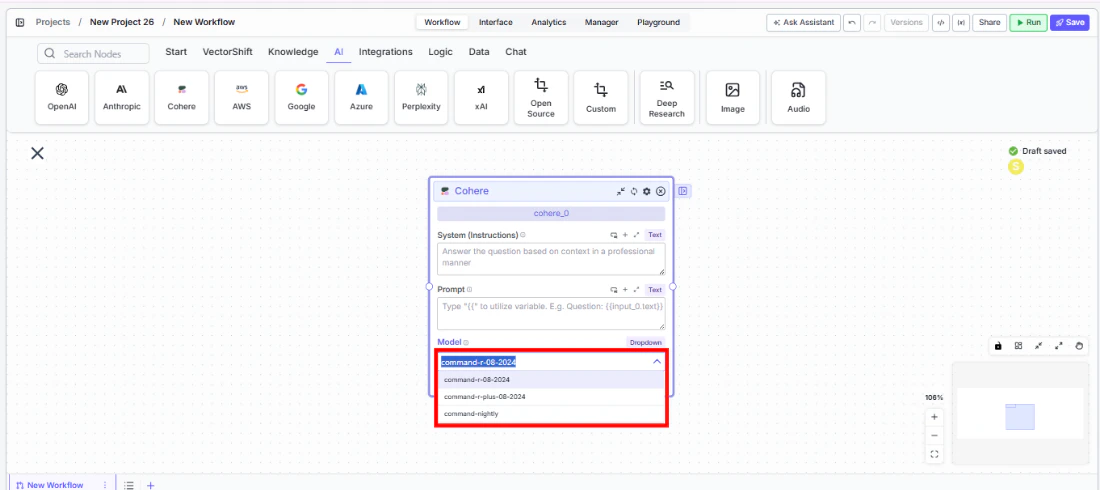
Select a model. Use the
Modeldropdown to choose a Cohere model. Available options includecommand-r-06-2024,command-r-08-2024,command-r-plus-08-2024, andcommand-nightly.
-
Use a personal API key (optional). Toggle
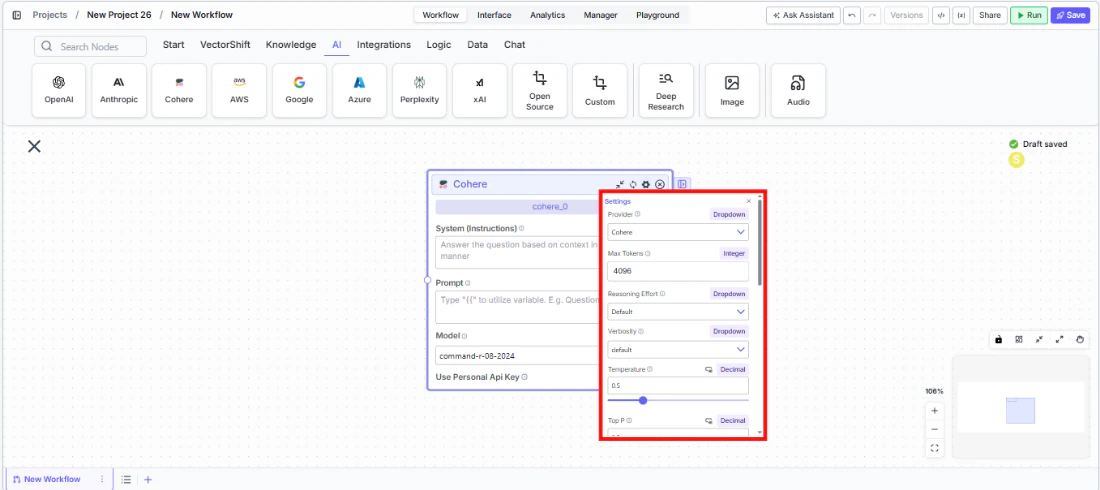
Use Personal Api Keyto Yes to use your own Cohere API key. AnApi Keyfield appears — paste your key there. The node will display a validation error (“Api Key field is Required!”) if the field is left blank. - Open settings. Click the gear icon (⚙) on the node to open the settings panel, where you can configure token limits, temperature, retry behavior, safety features, and more.
- Connect outputs. Click the Outputs button to open the outputs panel. Wire the
responseoutput to downstream nodes. Usetokens_used,input_tokens,output_tokens, andcredits_usedfor monitoring.
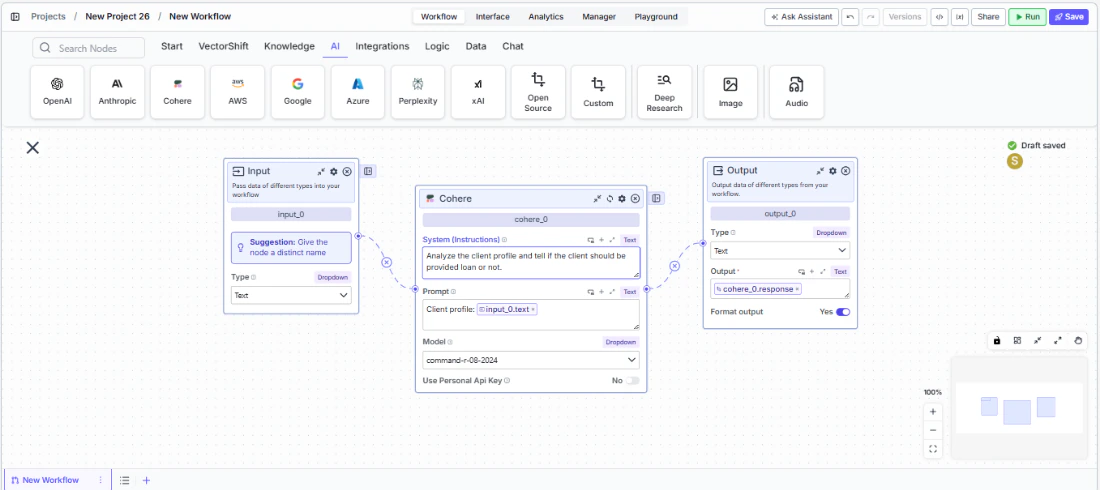
- Run your workflow. Execute the workflow. The Cohere node processes its inputs and returns the generated response along with usage metrics.
Settings
All settings below are accessed via the gear icon (⚙) on the node.Best Practices
- Leverage Cohere for RAG workflows. Cohere Command models are optimized for retrieval-augmented generation — pair the Cohere node with a Knowledge Base Reader for accurate, grounded responses to financial queries.
- Use JSON mode for structured extraction. When pulling data from financial documents, enable
JSON Responseand provide a schema to ensure consistent output across runs. - Monitor token usage. Connect
tokens_usedandcredits_usedoutputs to tracking nodes for cost visibility, especially when processing large document batches. - Enable Safe Context Token Window for variable-length inputs. Prevents token-limit errors when processing documents of unpredictable size.
- Apply PII detection for sensitive data. Enable relevant PII toggles (including SSN) when processing client financial records or personal information.
- Use streaming for interactive interfaces. Enable streaming when the Cohere node powers a client-facing chatbot for a more responsive user experience.