
Opening the metadata editor
Click Configure Metadata in the top-right area of the knowledge base detail page.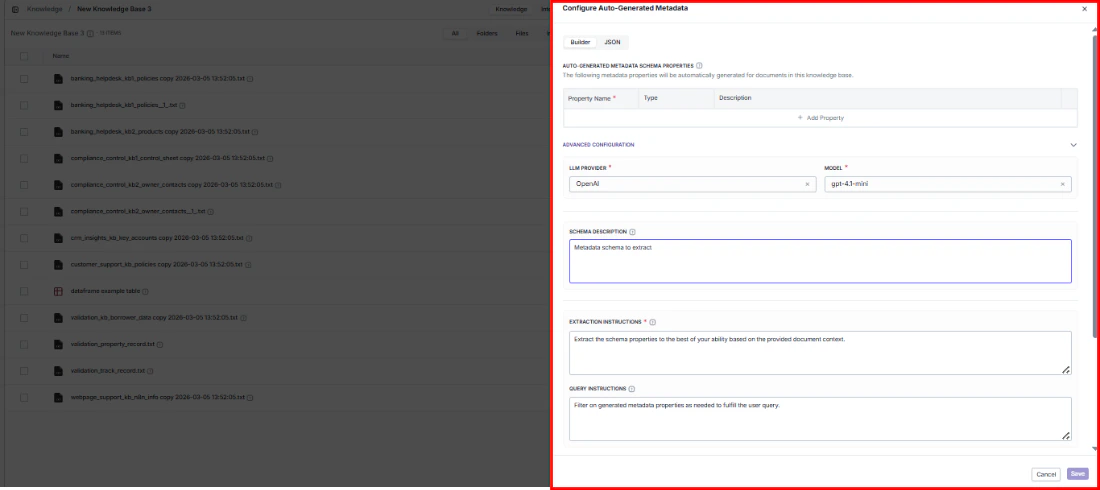
What you can configure
Schema properties
Define what metadata fields the AI should extract from each document. Each property has:
Click + Add Property to add fields, or remove existing ones you no longer need.
Switch between Builder mode (visual editor) and JSON mode (read-only view of the generated schema — useful for copying into API calls or external tools).
Advanced configuration
Fine-tune how the AI extracts metadata to get more accurate, consistent results:- LLM provider and Model: Choose which AI model performs the extraction (e.g., OpenAI / gpt-4.1-mini).
- Schema description: Give the AI context about what kinds of documents it will process and what the metadata is for.
- Extraction instructions: Set specific rules for how values should be extracted (e.g., “Always extract dates in ISO 8601 format” or “If the author is not explicitly stated, leave the field empty”).
- Query instructions: Tell the search system how to apply metadata filters when users search — this ensures filters behave the way your users expect.
Context configuration
These options require Advanced Document Analysis to be enabled in the knowledge base’s permanent settings.
- Document item context: Choose how much of each document the AI sees — Short Summary (fast), Long Summary (more accurate), or Full Document (most accurate, uses more tokens). You can select one or more.
- Sibling context: Enable when related documents in the same folder share context (e.g., chapters of the same report).
- Parent context: Enable when your folder structure carries meaning (e.g., documents inside a “Legal” folder should be recognized as legal documents).