If you are building your own application and want to integrate chatbot functionality into it, you can call the chatbot directly through the VectorShift API. This gives you full control over how messages are sent and responses are displayed, and it supports both synchronous and streaming responses.

Prerequisites

Your chatbot must be deployed before making API calls. Toggle Deployment Enabled in the chatbot builder’s Export tab. See Share via link for deployment details. You also need your VectorShift API key, which you can find by clicking your profile icon in the top-left corner of the VectorShift app, then clicking API Keys.
The profile menu with API Keys highlighted The API Keys page

How it works

You send a POST request to the chatbot endpoint with your message. VectorShift runs the connected workflow and returns the chatbot’s response. To maintain conversation continuity across multiple messages, you include the conversation_id from the previous response in each subsequent request.
  1. First message: Send your text without a conversation_id. The API returns the bot’s response along with a new conversation_id.
  2. Subsequent messages: Include the conversation_id from the previous response. The chatbot retrieves the conversation history and responds in context.
  3. New conversation: Omit the conversation_id to start a fresh conversation at any time.
Always store the conversation_id from the first response and include it in every subsequent call. Without it, each call starts a new conversation and the chatbot loses context.

Endpoint

POST https://api.vectorshift.ai/api/chatbots/run

Request headers

HeaderValue
Content-Typeapplication/json
Api-KeyYour VectorShift API key

Request body

FieldTypeRequiredDescription
inputstringYesThe user’s message
chatbot_namestringYes (or chatbot_id)The name of the chatbot to run
chatbot_idstringYes (or chatbot_name)The ID of the chatbot to run
conversation_idstringNoThe conversation ID from a previous response. Omit to start a new conversation.
streambooleanNoSet to true to receive the response as a stream of Server-Sent Events (SSE). Defaults to false.

Response (non-streaming)

{
  "status": "success",
  "output": "Your order #12345 is currently in transit and expected to arrive by Friday.",
  "conversation_id": "abc123def456"
}
FieldDescription
status"success" or "failed"
outputThe chatbot’s response text
conversation_idStore this and include it in the next request to continue the conversation

Response (streaming)

When stream is set to true, the response is delivered as Server-Sent Events. Each event contains a chunk of the response text. The final event includes the complete output and the conversation_id.

Code examples

Python

import requests

API_KEY = "your_api_key"
CHATBOT_ID = "your_chatbot_id"

url = "https://api.vectorshift.ai/api/chatbots/run"

headers = {
    "Content-Type": "application/json",
    "Api-Key": API_KEY,
}

# First message (no conversation_id)
payload = {
    "input": "Where is my order #12345?",
    "chatbot_id": CHATBOT_ID,
}

response = requests.post(url, json=payload, headers=headers)
data = response.json()

print(data["output"])
conversation_id = data["conversation_id"]

# Follow-up message (with conversation_id)
payload = {
    "input": "Can I change the shipping address?",
    "chatbot_id": CHATBOT_ID,
    "conversation_id": conversation_id,
}

response = requests.post(url, json=payload, headers=headers)
data = response.json()

print(data["output"])

JavaScript

const API_KEY = "your_api_key";
const CHATBOT_ID = "your_chatbot_id";

const url = "https://api.vectorshift.ai/api/chatbots/run";

// First message (no conversation_id)
const firstResponse = await fetch(url, {
  method: "POST",
  headers: {
    "Content-Type": "application/json",
    "Api-Key": API_KEY,
  },
  body: JSON.stringify({
    input: "Where is my order #12345?",
    chatbot_id: CHATBOT_ID,
  }),
});

const firstData = await firstResponse.json();
console.log(firstData.output);

const conversationId = firstData.conversation_id;

// Follow-up message (with conversation_id)
const followUpResponse = await fetch(url, {
  method: "POST",
  headers: {
    "Content-Type": "application/json",
    "Api-Key": API_KEY,
  },
  body: JSON.stringify({
    input: "Can I change the shipping address?",
    chatbot_id: CHATBOT_ID,
    conversation_id: conversationId,
  }),
});

const followUpData = await followUpResponse.json();
console.log(followUpData.output);

cURL

# First message (no conversation_id)
curl -X POST https://api.vectorshift.ai/api/chatbots/run \
  -H "Content-Type: application/json" \
  -H "Api-Key: your_api_key" \
  -d '{
    "input": "Where is my order #12345?",
    "chatbot_id": "your_chatbot_id"
  }'

# Follow-up message (include conversation_id from the first response)
curl -X POST https://api.vectorshift.ai/api/chatbots/run \
  -H "Content-Type: application/json" \
  -H "Api-Key: your_api_key" \
  -d '{
    "input": "Can I change the shipping address?",
    "chatbot_id": "your_chatbot_id",
    "conversation_id": "abc123def456"
  }'

Error handling

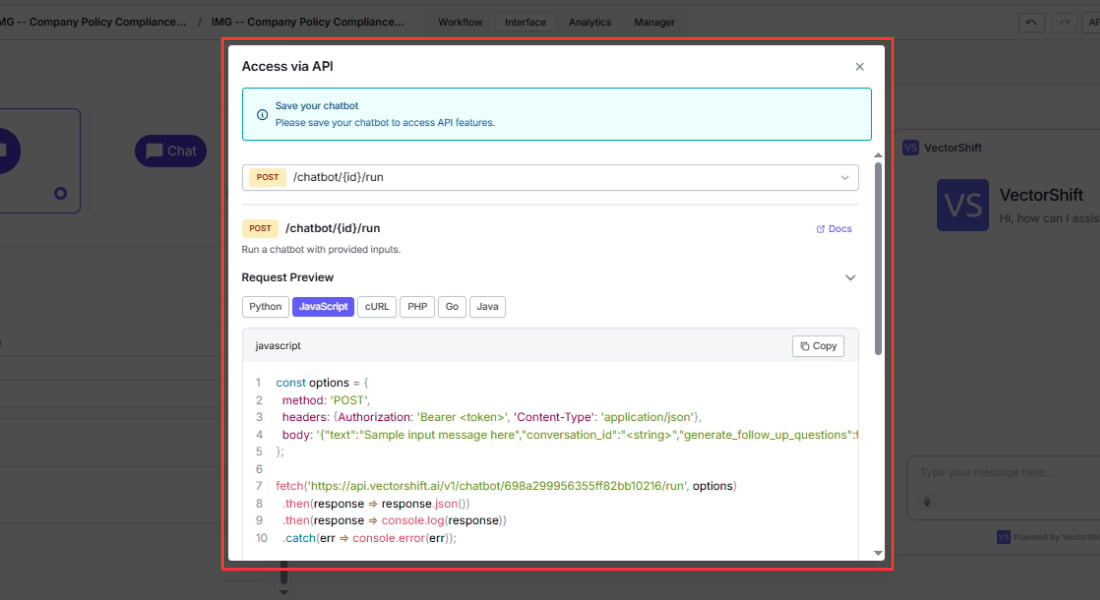
If the chatbot fails to run (for example, the connected workflow encounters an error), the response will have "status": "failed" and include an error message. Check that your chatbot is deployed and that the connected workflow is functioning correctly. For the full API reference, including upload, terminate, and listing endpoints, see the API Reference. The API export snippet in the chatbot builder's Export tab

Next steps

Analytics and conversation history

Track usage, review conversations, and export data

Sharing and deploying

Explore other deployment channels