Analytics tab
The Analytics tab shows performance data for the workflow or Agent powering your chatbot. It has two sub-tabs: Dashboard and Traces.Controls
At the top of the Analytics tab, three controls let you slice the data:- Date range — presets include 24 hours, 7 days, 30 days, 3 months, 1 year, or a custom range. All charts update to match.
- Granularity — choose how data points are grouped: Hourly, Daily, Weekly, Monthly, Yearly, or All Time.
- Filter — narrow charts to a specific workflow or Agent by name.
Dashboard
The Dashboard shows five metric panels:Runs
The Runs area chart shows the total number of workflow executions over time. The header displays Total runs for the selected period. Use this to spot adoption trends, identify peak usage periods, and measure the impact of changes like adding the chatbot to a new channel.Failures
The Failures chart shows how many runs failed during the selected period. The header displays Total failures. A healthy chatbot should have near-zero failures. Use this to catch broken workflows early — a sudden spike usually means a recent change introduced an error. Cross-reference with the Traces table to find the root cause.Model Costs
The Model Costs panel shows the total spend for the selected period in USD. The breakdown table lists each model used, the number of tokens consumed, and the cost in USD. Use this to track LLM spend and compare costs across model versions.Workflow Latency
The Workflow Latency chart shows average end-to-end workflow latency in seconds over time. Switch between the 50th, 75th, 90th, and 99th percentile views to understand your typical and worst-case response times. Use this to detect regressions after workflow changes.Model Usage
The Model Usage chart shows total token consumption over time. Toggle between Tokens and AI Credits views. Use the All models dropdown to filter to a specific model. Use this to monitor consumption trends and plan capacity.Average node latencies
Below the charts, the Average node latencies panel shows the average processing time for each node in the workflow. Use this to identify bottlenecks — if one node is consistently slow, that is where to start optimizing.Traces
The Traces sub-tab lists every individual workflow execution as a row in the Workflow Traces table.
Use the Filter button to narrow traces by status, source, or other fields.
How to access the Manager tab
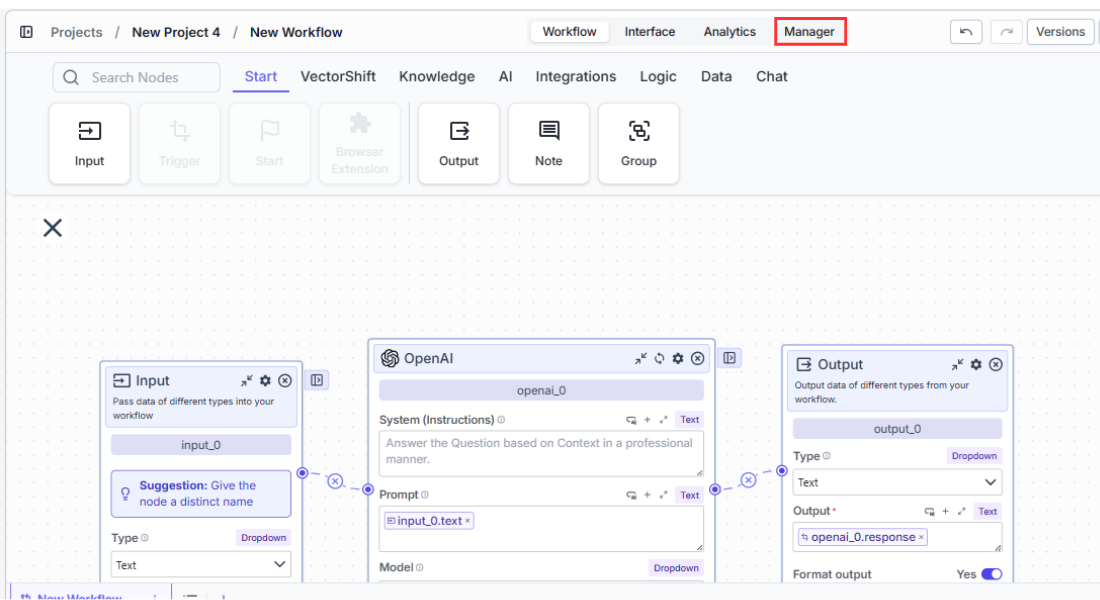
There are two ways to reach the Manager view:- From the Chatbots page: Click Manage chatbot analytics at the top of the Chatbots tab.
- From inside the chatbot builder: Open the chatbot you want to inspect and click the Manager tab.
Understanding the Manager dashboard
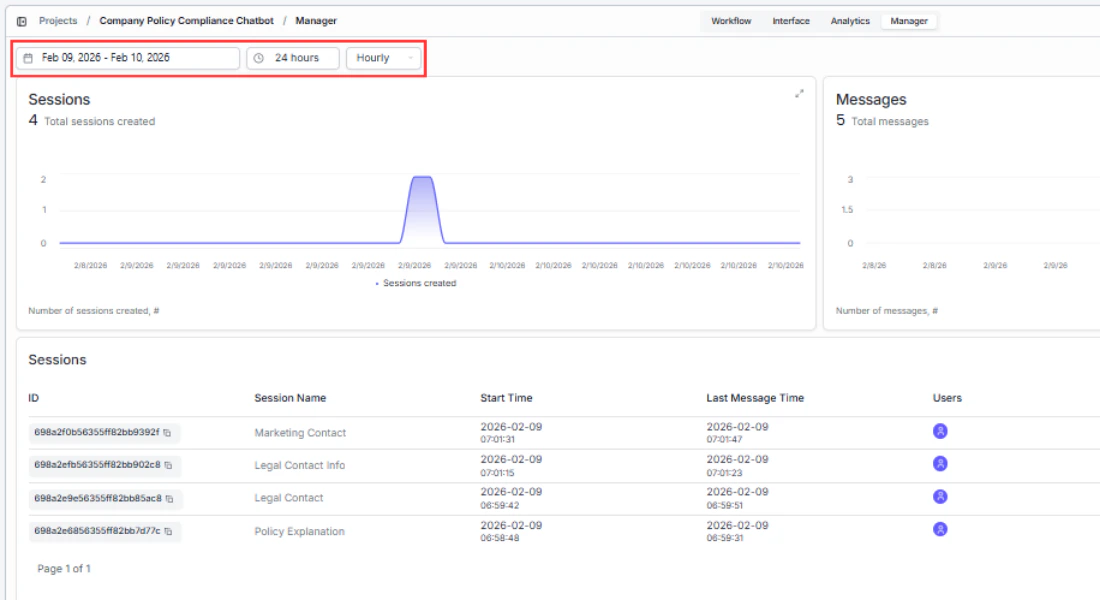
The dashboard has three sections: charts that show trends at a glance, a feedback view, and a conversations table for drilling into individual exchanges.Date range selector
Use the date picker at the top to focus on a specific time window. All charts and the table update to match your selection. Use this to:- Compare periods — check if a workflow change last week improved or worsened performance.
- Investigate incidents — narrow the range to a specific day when users reported problems.
- Track growth — expand to a monthly view to see adoption trends over time.
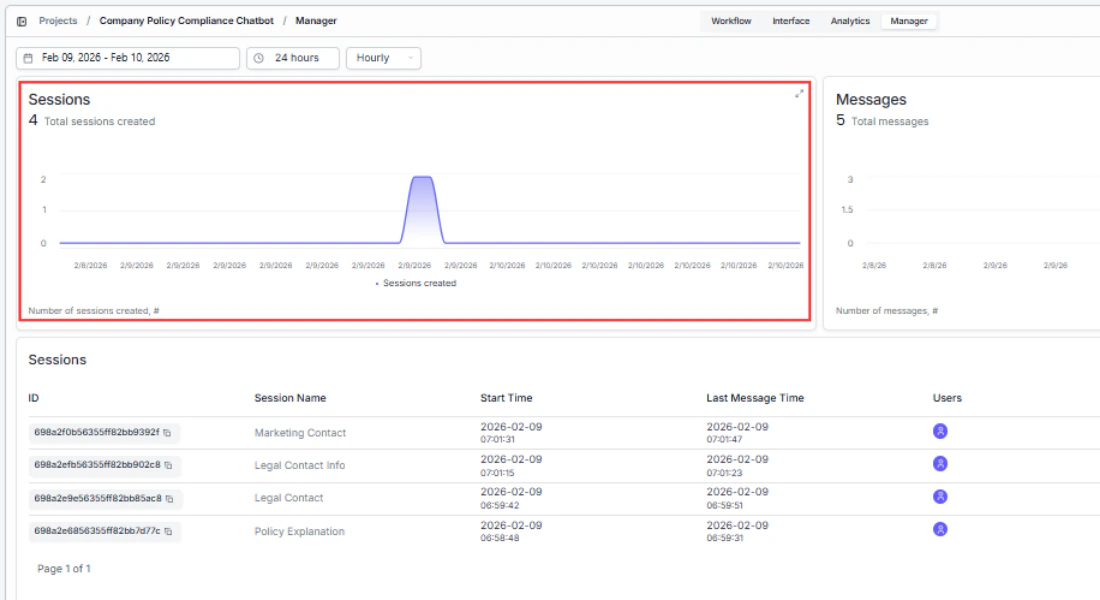
Runs chart — “How much is my chatbot being used?”
The Runs area chart shows conversation volume over time. Each data point represents the number of chatbot runs for that day. Use this to:- Spot adoption trends — a steady increase means users are finding and returning to the chatbot.
- Identify peak hours/days — schedule workflow updates or maintenance during low-traffic periods.
- Measure the impact of changes — if you added the chatbot to a new page or channel, you should see a corresponding spike.
Failures chart — “Is my chatbot reliable?”
The Failures bar chart shows how many runs failed during the selected period. A healthy chatbot should have near-zero failures. Use this to:- Catch broken workflows early — a sudden spike usually means a recent workflow change introduced an error.
- Detect rate limits — gradual increases in failures during peak hours may indicate you’re hitting API rate limits.
- Correlate with external outages — if failures spike across all chatbots simultaneously, the issue is likely upstream (e.g., an LLM provider outage).
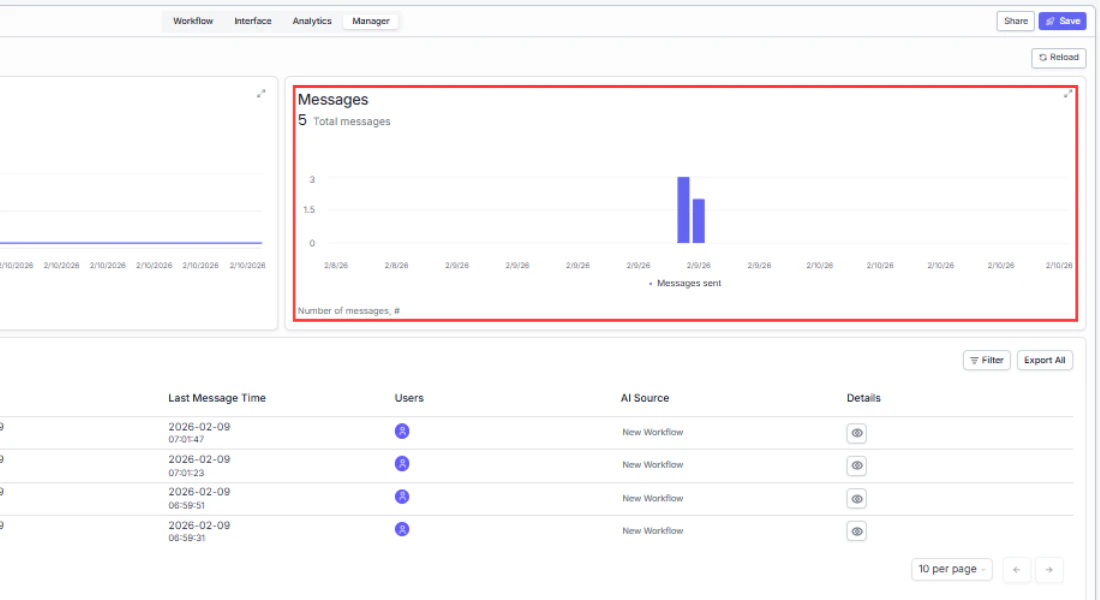
Feedback chart — “Are users happy with the responses?”
The Feedback chart visualizes the thumbs-up and thumbs-down reactions users give to bot responses. This chart only shows data if you’ve enabled the Turn On User Feedback toggle in the chatbot’s customization settings. Use this to:- Measure response quality — a high ratio of negative feedback means your workflow’s prompts, knowledge base, or LLM configuration needs work.
- Track improvement over time — after updating your workflow, check whether positive feedback increases.
- Identify problem areas — pair feedback trends with conversation transcripts to find which topics produce the most negative reactions.
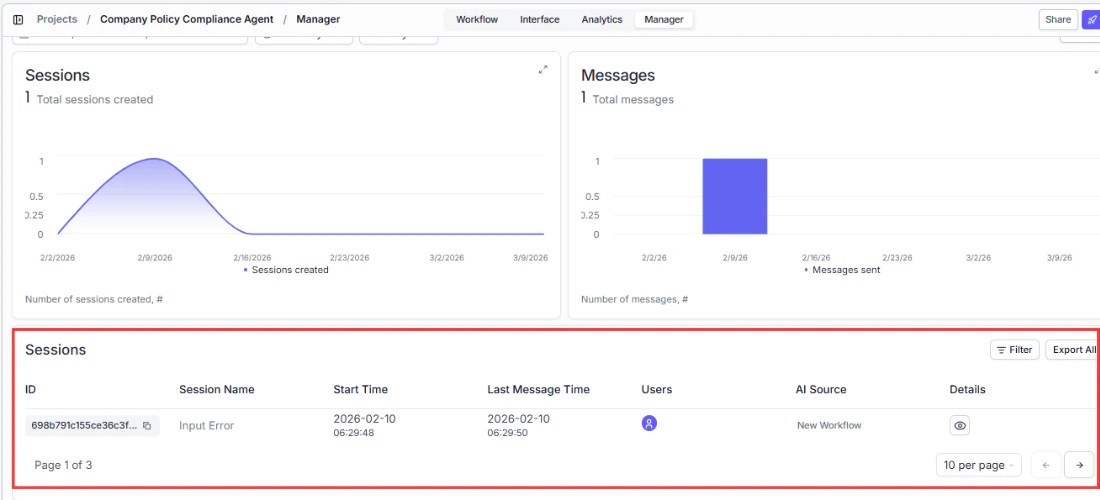
Conversations table
Below the charts, a table lists every conversation for the selected chatbot. Each row is one conversation thread. This is where you go from high-level trends to specific interactions.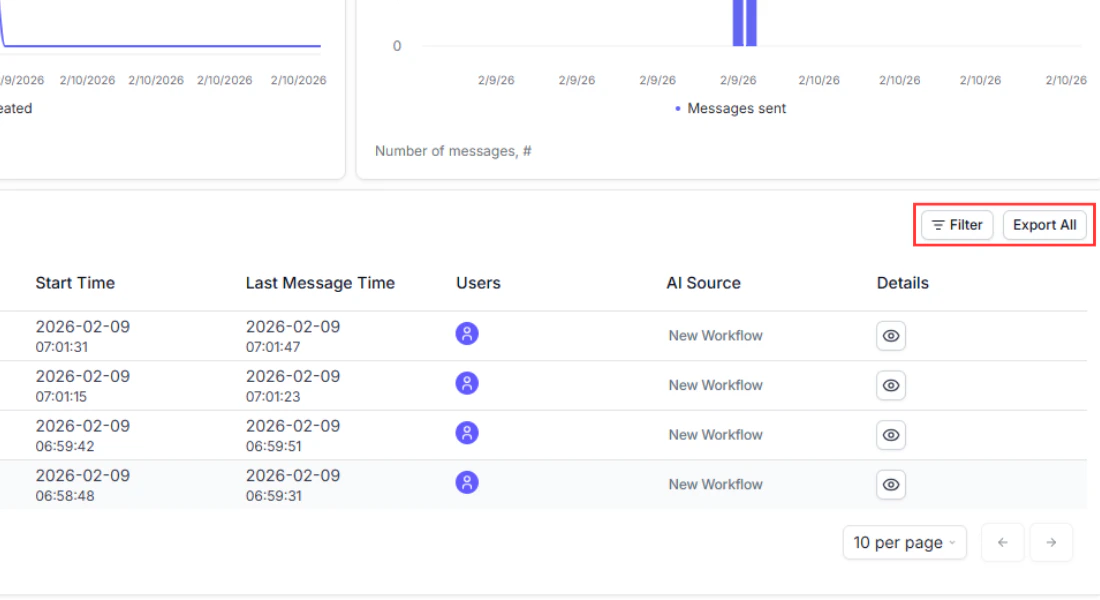
Viewing a conversation
Click View on any row to open the full message exchange. You see every message in chronological order with timestamps. Use this to:- Debug unexpected answers — read what the user asked and what the bot said to understand why a response was off.
- Audit for quality — spot-check conversations to ensure the bot stays on-topic and accurate.
- Discover training gaps — find questions the bot couldn’t answer well, then update your workflow’s knowledge base or prompts accordingly.
Filtering and exporting
Filtering — find the conversations that matter
Click the Filter button above the table to narrow results:- Status — show only Success or Failure conversations. Use this to quickly isolate failures and investigate what went wrong.
- Source — filter by deployment channel (web, Slack, Twilio, API). Useful for comparing performance across channels, for example: “Are Slack users getting better answers than web users?”
- Text search — search by conversation name, user email, or error message content. Use this to find a specific user’s conversations or all conversations that hit the same error.
Exporting individual conversations
Click Export on any row and choose CSV or JSON to download that conversation’s full message history. Use this when:- You need to share a specific conversation with your team for debugging.
- A user reports a problem and you want to review exactly what happened.
Exporting all conversations
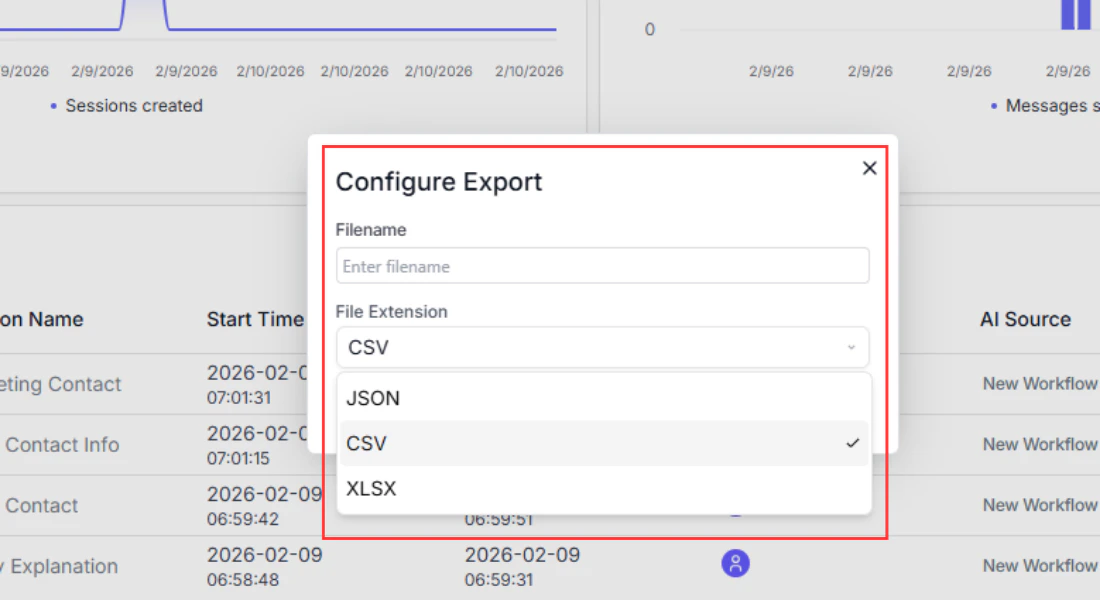
Click Export All at the top of the table to download every conversation in the current date range as CSV or JSON. Use this to:- Import into a spreadsheet for bulk analysis.
- Feed into your own analytics pipeline or BI tool.
- Create training datasets from real user conversations to improve your workflow.
Using your analytics data
The analytics dashboard helps you answer questions like:- Are users satisfied? Check the Feedback chart. A high ratio of negative reactions suggests the chatbot’s responses need improvement, whether through better workflow logic, updated knowledge base content, or clearer prompts.
- Is the chatbot reliable? Look at the Failures chart. A sudden spike in failures likely correlates with a workflow change or an external service outage. Cross-check with the Error Message column in the conversations table to find the root cause.
- Where is traffic coming from? The Source column tells you which deployment channel is generating the most conversations, helping you decide where to focus optimization efforts.
- What are users asking about? Open individual conversations to read the actual exchanges. Look for patterns in questions that the chatbot struggles with, and use those insights to improve your workflow’s knowledge base or prompts.
Next steps
If your analytics reveal issues with chatbot performance, revisit the workflow powering it or adjust the chatbot’s configuration:Workflow chatbot
Review the workflow connection and input/output mapping
Chat Assistant
Adjust prompts, feedback settings, and follow-up question generation