> ## Documentation Index
> Fetch the complete documentation index at: https://docs.vectorshift.ai/llms.txt
> Use this file to discover all available pages before exploring further.
# Configuring a Portal
> How to configure portal settings including basics, tabs, workspace, styling, and security
Click **Edit Portal** on any portal to open the editor. The left panel is where you configure everything; the right panel shows a live preview that updates as you make changes — so you can see exactly what your users will get before you save.
The top bar gives you **Undo / Redo** controls, access to **Version history** (to browse or restore previous configurations), and a **Save** button.
The configuration panel is organized into four sections: Basics, Tabs, Styling, and Security. Workspace configuration has its own dedicated page — see [Workspace](/platform/portals/workspace).
## Basics
This is where you define what your portal is and what it offers.
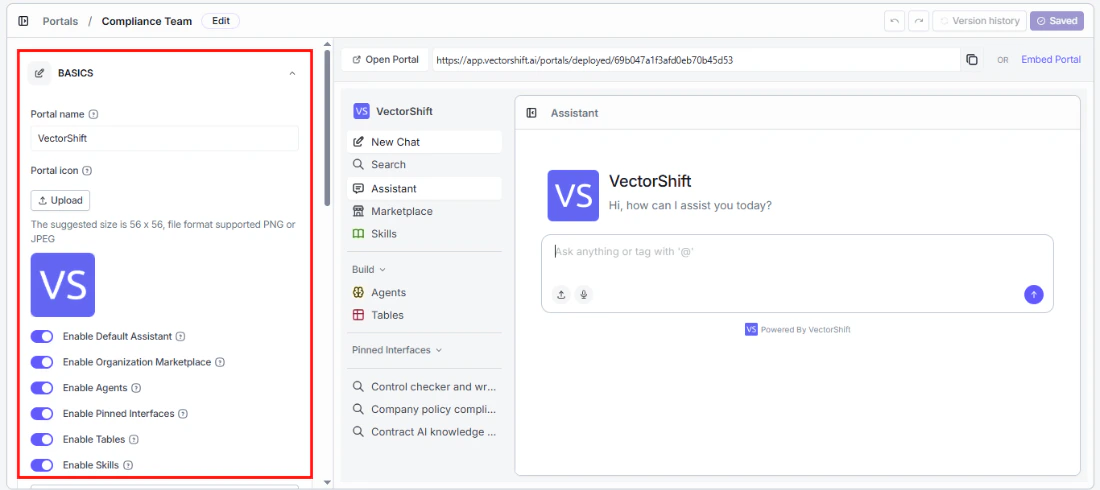 ### Portal name
The name your users see. Choose something descriptive — "Customer Support Hub" is more helpful than "Portal 1."
### Portal icon
Upload a custom icon (PNG or JPEG, 56x56px recommended) to give your portal a recognizable identity. This appears in the top left corner of the portal.
### Feature toggles
These toggles control what your users can access inside the portal. Turn on only what is relevant to your audience — a cleaner portal means less confusion and faster onboarding.
* **Enable Default Assistant**: Give users an agentic chat interface where they can ask questions, tag specific interfaces with `@`, and upload files.
* **Enable Organization Marketplace**: Let users discover and deploy templates from your organization's shared library.
* **Enable Agents**: Let users view, interact with, and build their own agents inside the portal.
* **Enable Pinned Interfaces**: Surface specific interfaces directly in the sidebar for one-click access.
* **Enable Tables**: Let users view and work with data tables, or create their own.
* **Enable Skills**: Let users view and create reusable content blocks that agents and interfaces can reference.
Less is more. If your support team only needs the assistant and two pinned interfaces, disable everything else. They will thank you for the clean experience.
### Add Template
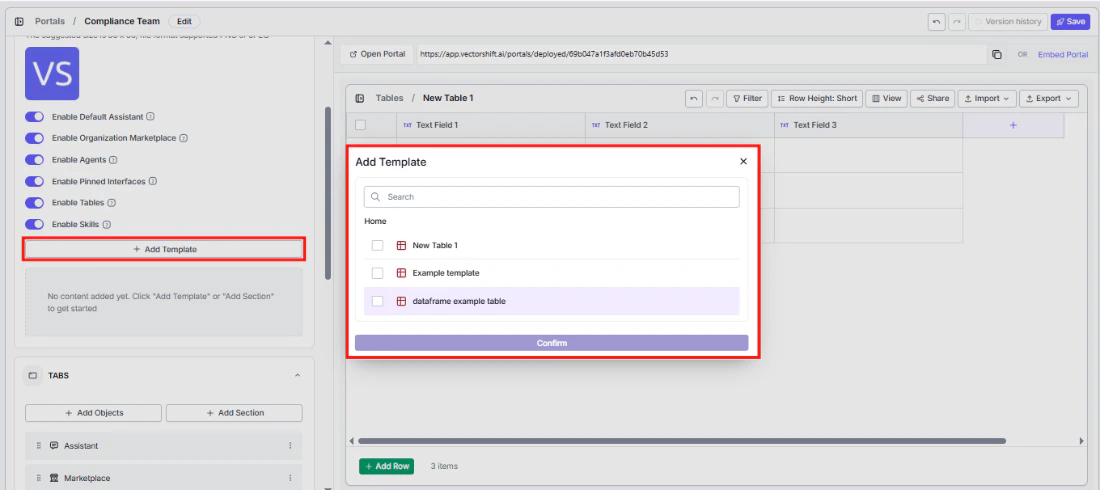
If you have enabled Tables, you can provide your users with a head start by adding table templates. Click **+ Add Template** to select one of your existing tables as a starting point. Users can then create new tables from that template or build from scratch.
### Portal name
The name your users see. Choose something descriptive — "Customer Support Hub" is more helpful than "Portal 1."
### Portal icon
Upload a custom icon (PNG or JPEG, 56x56px recommended) to give your portal a recognizable identity. This appears in the top left corner of the portal.
### Feature toggles
These toggles control what your users can access inside the portal. Turn on only what is relevant to your audience — a cleaner portal means less confusion and faster onboarding.
* **Enable Default Assistant**: Give users an agentic chat interface where they can ask questions, tag specific interfaces with `@`, and upload files.
* **Enable Organization Marketplace**: Let users discover and deploy templates from your organization's shared library.
* **Enable Agents**: Let users view, interact with, and build their own agents inside the portal.
* **Enable Pinned Interfaces**: Surface specific interfaces directly in the sidebar for one-click access.
* **Enable Tables**: Let users view and work with data tables, or create their own.
* **Enable Skills**: Let users view and create reusable content blocks that agents and interfaces can reference.
Less is more. If your support team only needs the assistant and two pinned interfaces, disable everything else. They will thank you for the clean experience.
### Add Template
If you have enabled Tables, you can provide your users with a head start by adding table templates. Click **+ Add Template** to select one of your existing tables as a starting point. Users can then create new tables from that template or build from scratch.
 ## Tabs
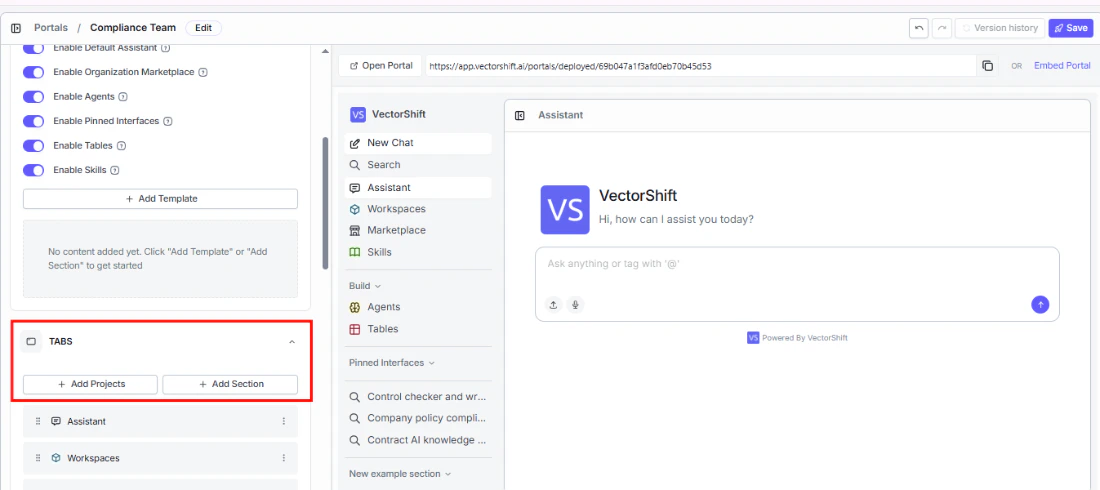
This is where you shape what your users see in the sidebar — and in what order.
## Tabs
This is where you shape what your users see in the sidebar — and in what order.
 ### Add Projects
Click **+ Add Projects** to make your existing projects and pipelines directly accessible to portal users. Browse or search the list, select what you want to include, and click Confirm.
### Add Projects
Click **+ Add Projects** to make your existing projects and pipelines directly accessible to portal users. Browse or search the list, select what you want to include, and click Confirm.
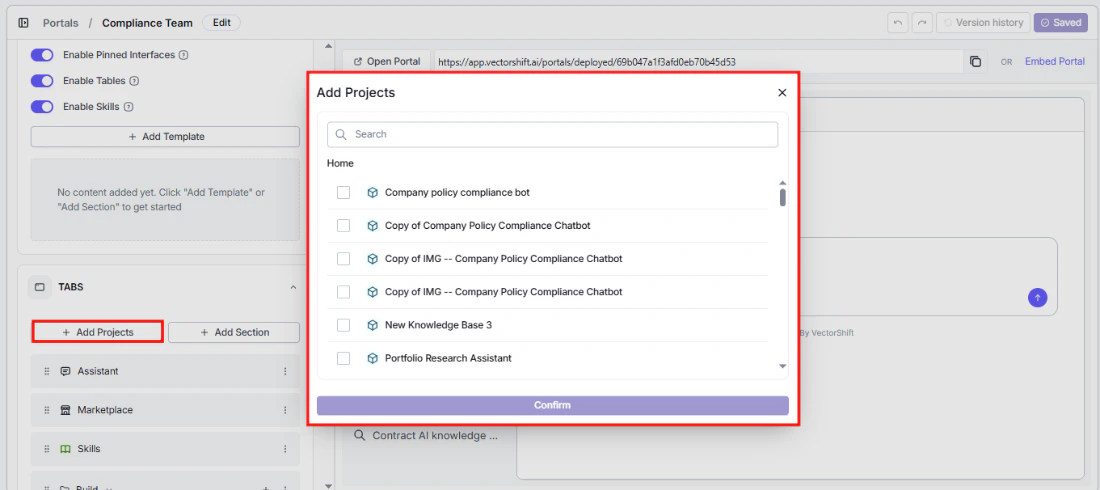 Portals cannot be added as tabs inside other portals — this prevents circular references.
### Add Section
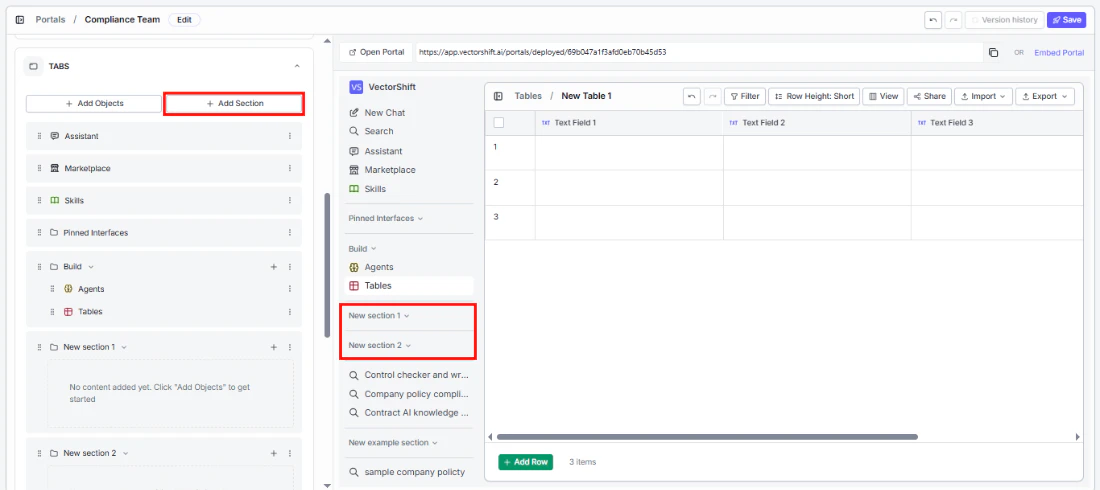
Keep your sidebar organized by grouping related tabs under collapsible headings. For example, create a "Research Tools" section and add all your research interfaces under it, so users do not have to hunt through a flat list.
Portals cannot be added as tabs inside other portals — this prevents circular references.
### Add Section
Keep your sidebar organized by grouping related tabs under collapsible headings. For example, create a "Research Tools" section and add all your research interfaces under it, so users do not have to hunt through a flat list.
 ### Tab list
The tab list shows everything currently in your portal's sidebar, in the order users will see it. The defaults are:
* **Assistant:** The agentic chat interface.
* **Marketplace:** Your organization's template library.
* **Build** (section): Contains Agents and Tables.
* **Pinned Interfaces** (section): Quick-access interfaces you have pinned.
* **Skills:** The skills library.
* Any projects you added during creation appear below these.
### Rearranging and removing tabs
You have full control over the sidebar layout. Drag any tab using the handle on the left to reorder it — the order here is exactly what your users see. Use the three-dot menu on the right to:
* **Edit:** Rename or reconfigure a tab.
* **Delete:** Remove it from the portal entirely.
Put the most important items at the top and remove anything that does not serve your audience.
Every default tab can be removed. If your users do not need the Marketplace or Build section, delete them — the portal only shows what you choose to keep.
Interfaces you pin inside a portal also appear pinned in the main Builder and Console views of your organization. Pinning is shared across views.
## Styling
Make the portal feel like your product, not a generic tool.
### Accent color
### Tab list
The tab list shows everything currently in your portal's sidebar, in the order users will see it. The defaults are:
* **Assistant:** The agentic chat interface.
* **Marketplace:** Your organization's template library.
* **Build** (section): Contains Agents and Tables.
* **Pinned Interfaces** (section): Quick-access interfaces you have pinned.
* **Skills:** The skills library.
* Any projects you added during creation appear below these.
### Rearranging and removing tabs
You have full control over the sidebar layout. Drag any tab using the handle on the left to reorder it — the order here is exactly what your users see. Use the three-dot menu on the right to:
* **Edit:** Rename or reconfigure a tab.
* **Delete:** Remove it from the portal entirely.
Put the most important items at the top and remove anything that does not serve your audience.
Every default tab can be removed. If your users do not need the Marketplace or Build section, delete them — the portal only shows what you choose to keep.
Interfaces you pin inside a portal also appear pinned in the main Builder and Console views of your organization. Pinning is shared across views.
## Styling
Make the portal feel like your product, not a generic tool.
### Accent color
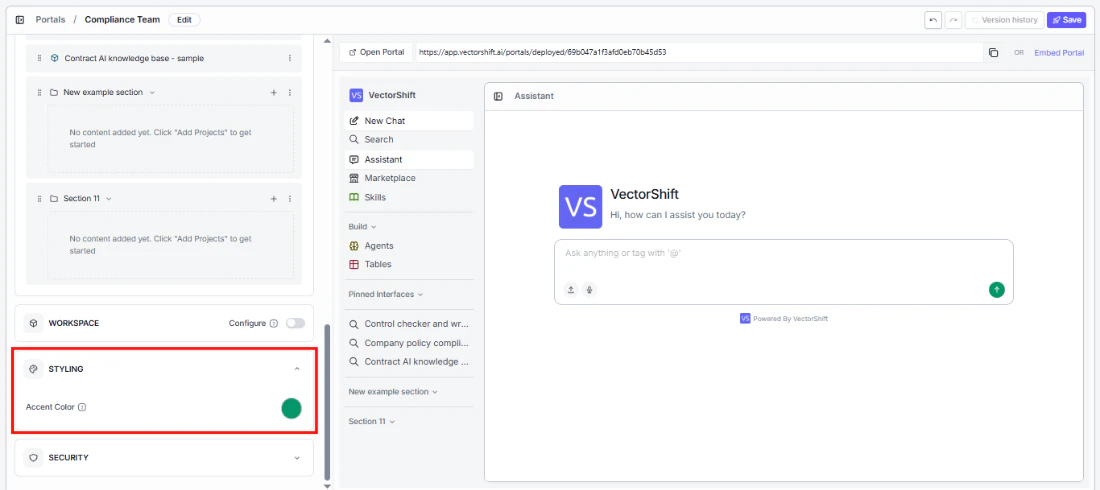 Set the primary accent color used for buttons, highlights, and active states throughout the portal. Click the color circle to open the picker.
Match this to your brand or your client's brand. A small detail like accent color goes a long way in making the portal feel like a native product rather than a third-party tool.
## Security
Control who can access your portal and how they authenticate.
### Protect with SSO Auth
Set the primary accent color used for buttons, highlights, and active states throughout the portal. Click the color circle to open the picker.
Match this to your brand or your client's brand. A small detail like accent color goes a long way in making the portal feel like a native product rather than a third-party tool.
## Security
Control who can access your portal and how they authenticate.
### Protect with SSO Auth
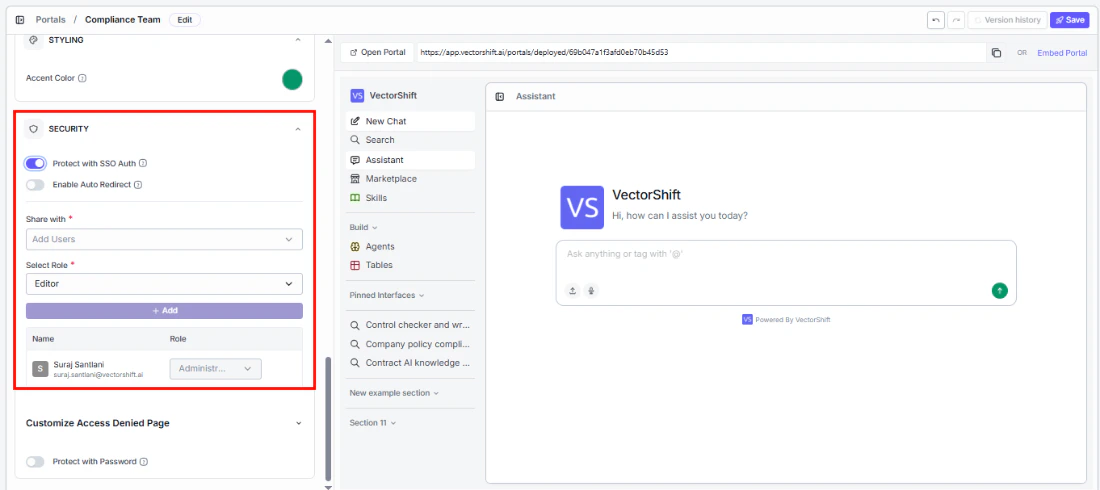 Require users to authenticate via Single Sign-On before they can access the portal. This is the recommended option for enterprise deployments where access should be tied to your identity provider.
* **Enable Auto Redirect:** When turned on, unauthenticated users are sent straight to the SSO login page instead of seeing an access denied screen — a smoother experience for your users.
### Share with (required)
Add specific users by name or email who should have access to this portal.
### Select Role (required)
Assign a role to control what each user can do:
* **Runner:** Can use the portal but cannot view or edit its configuration or any sub-objects.
* **Editor:** Can use, view, and edit the portal and its sub-objects.
* **Administrator:** Full control — can use, view, edit, delete, and share the portal and its sub-objects.
Click **+ Add** to confirm. The table below shows everyone who currently has access and their role — you can change roles directly from the table.
### Customize Access Denied page
When someone without permission tries to access your portal, they see an access denied screen. You can customize it to match your tone:
* **Permission Text:** The main message. Defaults to "You do not have permission to access this portal."
* **Contact Text:** Guidance on what to do next. Defaults to "Please contact the owner to request access."
* **Icon Color:** The color of the icon on the screen.
### Protect with Password
Require users to authenticate via Single Sign-On before they can access the portal. This is the recommended option for enterprise deployments where access should be tied to your identity provider.
* **Enable Auto Redirect:** When turned on, unauthenticated users are sent straight to the SSO login page instead of seeing an access denied screen — a smoother experience for your users.
### Share with (required)
Add specific users by name or email who should have access to this portal.
### Select Role (required)
Assign a role to control what each user can do:
* **Runner:** Can use the portal but cannot view or edit its configuration or any sub-objects.
* **Editor:** Can use, view, and edit the portal and its sub-objects.
* **Administrator:** Full control — can use, view, edit, delete, and share the portal and its sub-objects.
Click **+ Add** to confirm. The table below shows everyone who currently has access and their role — you can change roles directly from the table.
### Customize Access Denied page
When someone without permission tries to access your portal, they see an access denied screen. You can customize it to match your tone:
* **Permission Text:** The main message. Defaults to "You do not have permission to access this portal."
* **Contact Text:** Guidance on what to do next. Defaults to "Please contact the owner to request access."
* **Icon Color:** The color of the icon on the screen.
### Protect with Password
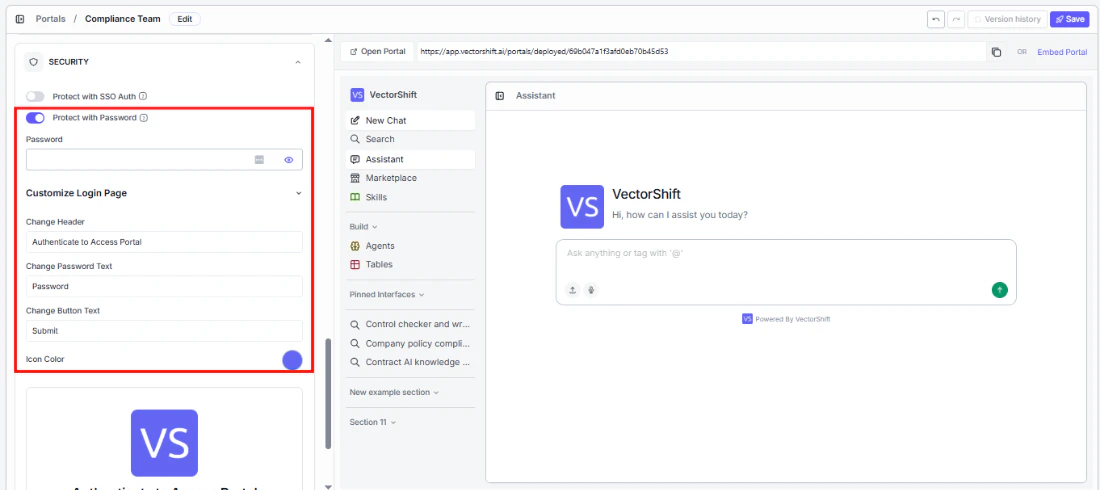 Set a password that users must enter before accessing the portal. This is a simpler alternative to SSO — useful for quick demos, external stakeholders, or situations where you do not need identity-based access control.
### Customize Login page
Make the password login screen feel on-brand. A live preview updates as you edit:
* **Change Header:** The heading text. Defaults to "Authenticate to Access Portal."
* **Change Password Text:** The label for the password field. Defaults to "Password."
* **Change Button Text:** The button label. Defaults to "Submit."
* **Icon Color:** The icon color on the login screen.
## Version history
Every time you save your portal configuration, it is preserved. Click **Version history** in the top bar to browse previous versions and restore any of them with one click.
Save a version before making big changes — it gives you a clean restore point if something does not work out.
Set a password that users must enter before accessing the portal. This is a simpler alternative to SSO — useful for quick demos, external stakeholders, or situations where you do not need identity-based access control.
### Customize Login page
Make the password login screen feel on-brand. A live preview updates as you edit:
* **Change Header:** The heading text. Defaults to "Authenticate to Access Portal."
* **Change Password Text:** The label for the password field. Defaults to "Password."
* **Change Button Text:** The button label. Defaults to "Submit."
* **Icon Color:** The icon color on the login screen.
## Version history
Every time you save your portal configuration, it is preserved. Click **Version history** in the top bar to browse previous versions and restore any of them with one click.
Save a version before making big changes — it gives you a clean restore point if something does not work out.